Ultrasound Fundamentals
Learn how medical ultrasound works, from the physics of a single wave to the design and regulation of the devices that use it — with 65 lessons, 16 interactive labs, and 14 engineering tools.
A look inside
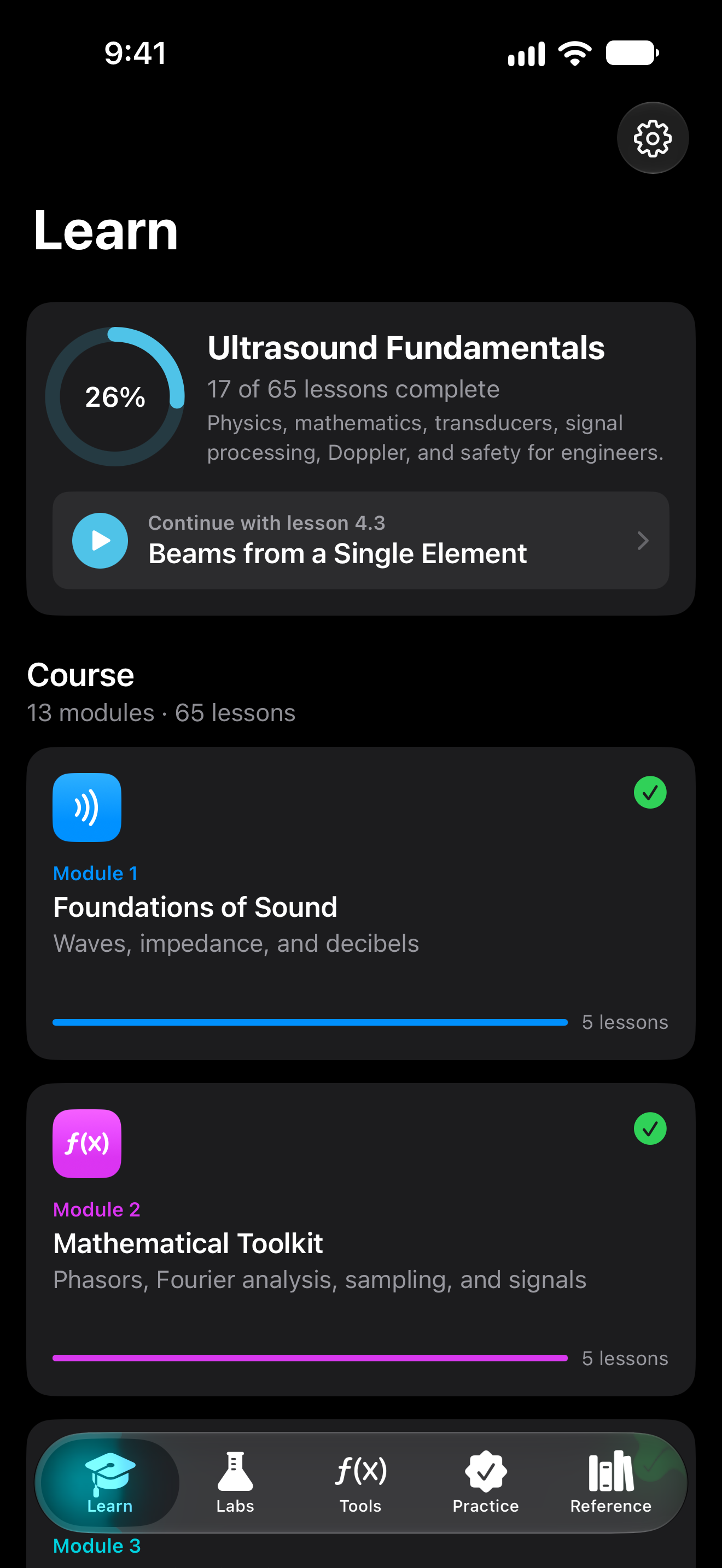
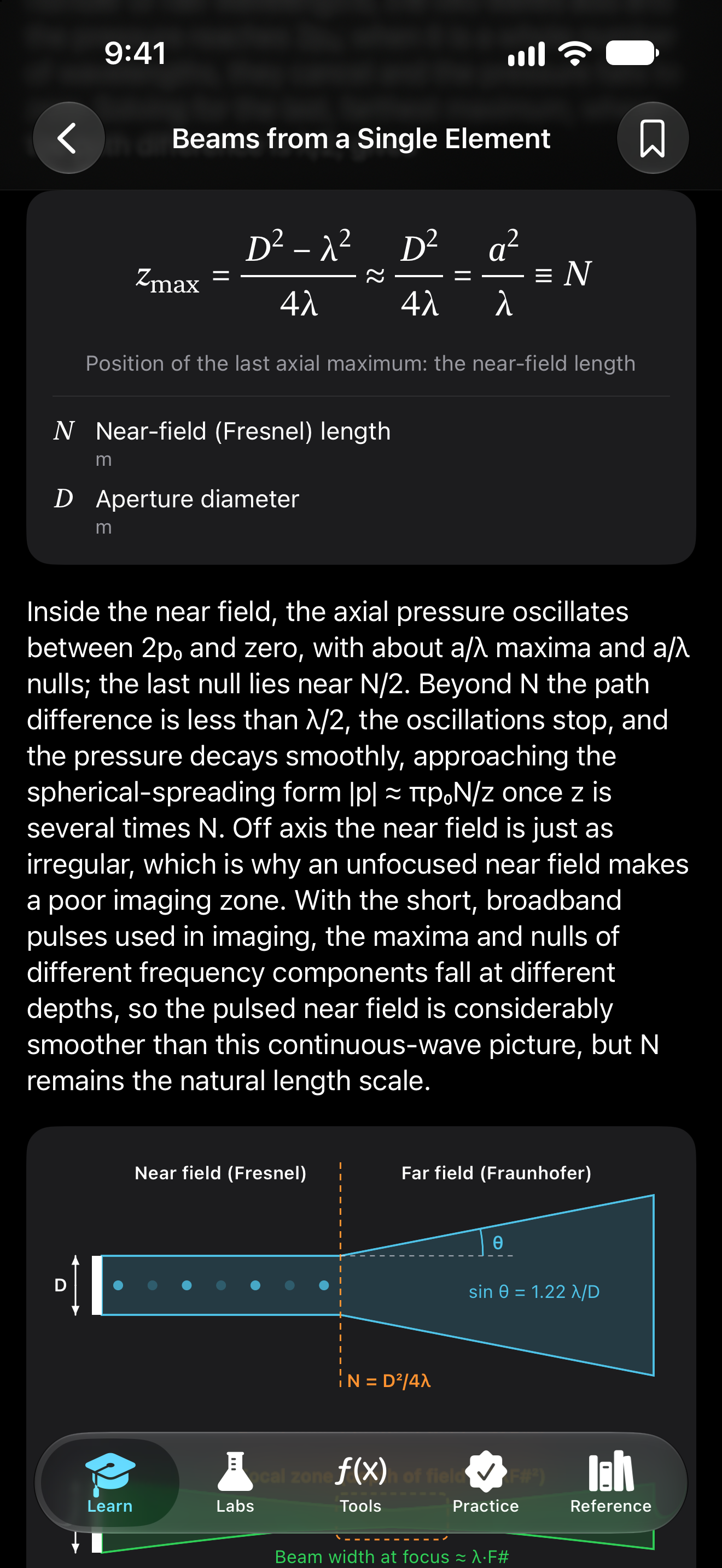
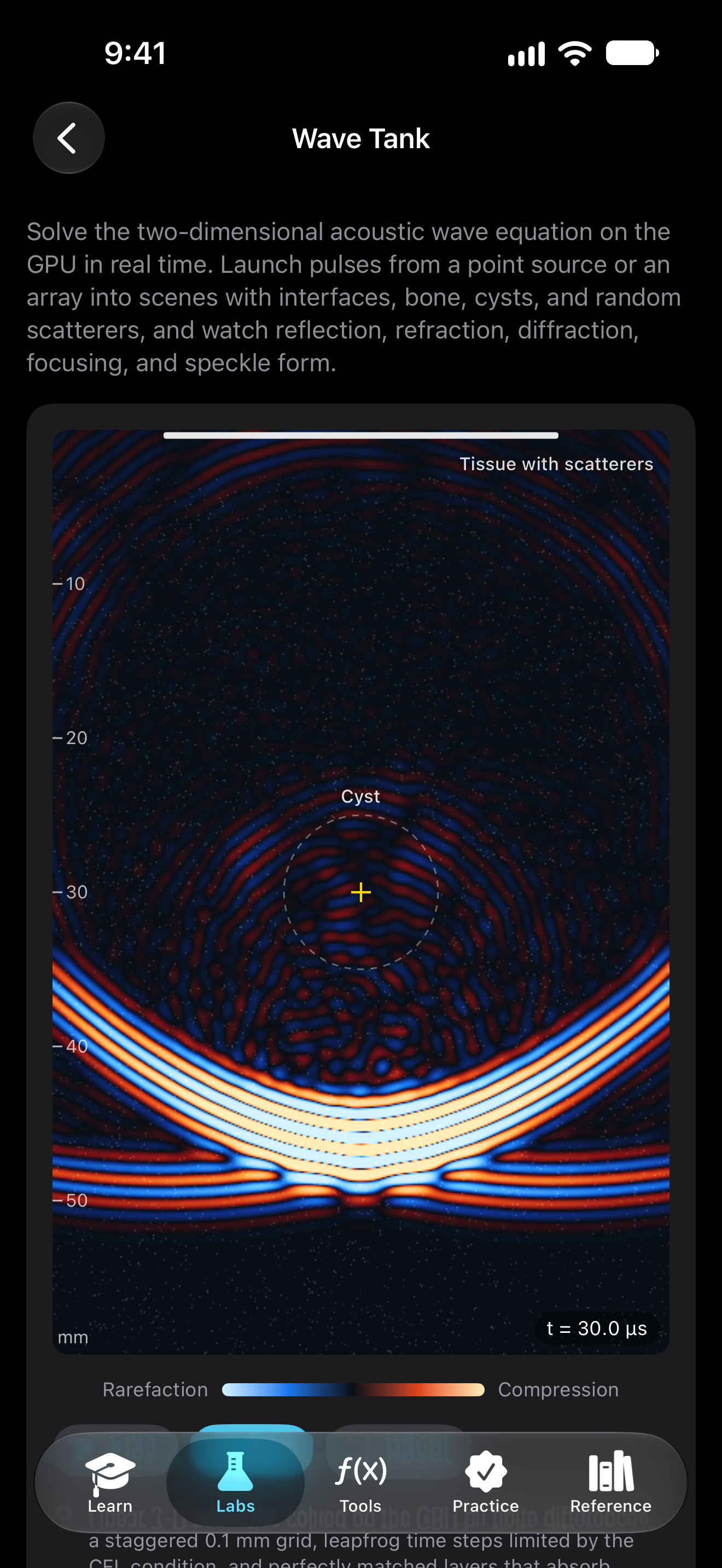
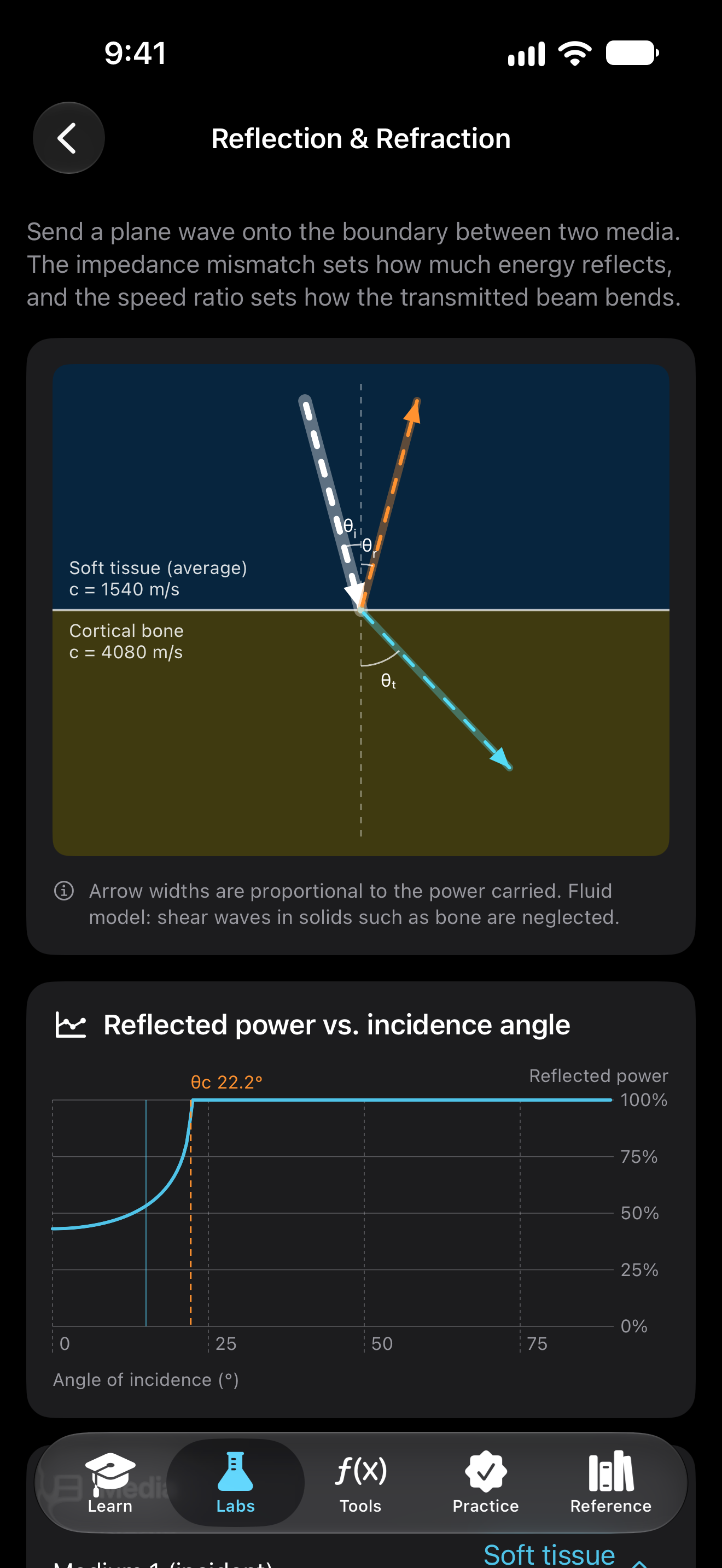
About Ultrasound Fundamentals
Ultrasound Fundamentals teaches how medical ultrasound works — from the physics of a single wave to the design, testing, and regulation of the devices that use it. Written for engineers, its lessons pair the equations behind each idea with illustrations, worked examples, and interactive labs and calculators. No account, no ads, no tracking.
Whether you design transducers or front-end electronics, write beamforming and signal-processing code, work in regulatory affairs or quality, or study biomedical engineering or physics, it takes you from first principles to how real systems are built, tested, and brought to market. Every lesson, lab, and tool works offline.
A complete course
13 modules and 65 lessons, from wave physics to elastography, therapy, and medical device engineering:
- 284 typeset equations, each with a legend of its symbols and units
- 94 worked examples with solutions you can reveal
- 58 native illustrations and diagrams
- Callouts for key ideas, engineering practice, clinical notes, pitfalls, and history
What you'll learn
- Foundations: waves, the acoustic wave equation, impedance, intensity, and decibels
- Mathematics: phasors, Fourier analysis, convolution, sampling, and the analytic signal
- Propagation in tissue: reflection, refraction, scattering and speckle, attenuation, and harmonics
- Transducers: piezoelectricity, construction, beams, arrays, manufacturing, and failure modes
- Beamforming: focusing, steering, receive beamforming, beam patterns, and plane-wave imaging
- Pulse-echo imaging: resolution, image formation, imaging modes, image quality, and performance testing
- Electronics: system architecture, transmit and receive chains, coded excitation, noise, and real-time computing
- Doppler: continuous-wave, pulsed, color, and power Doppler, spectral indices, and vector flow
- Image artifacts: propagation, attenuation, beam, and Doppler artifacts
- Safety and bioeffects: acoustic output, thermal and mechanical indices, regulation, and safety testing
- Advanced topics: elastography, contrast agents, therapeutic ultrasound, and research frontiers
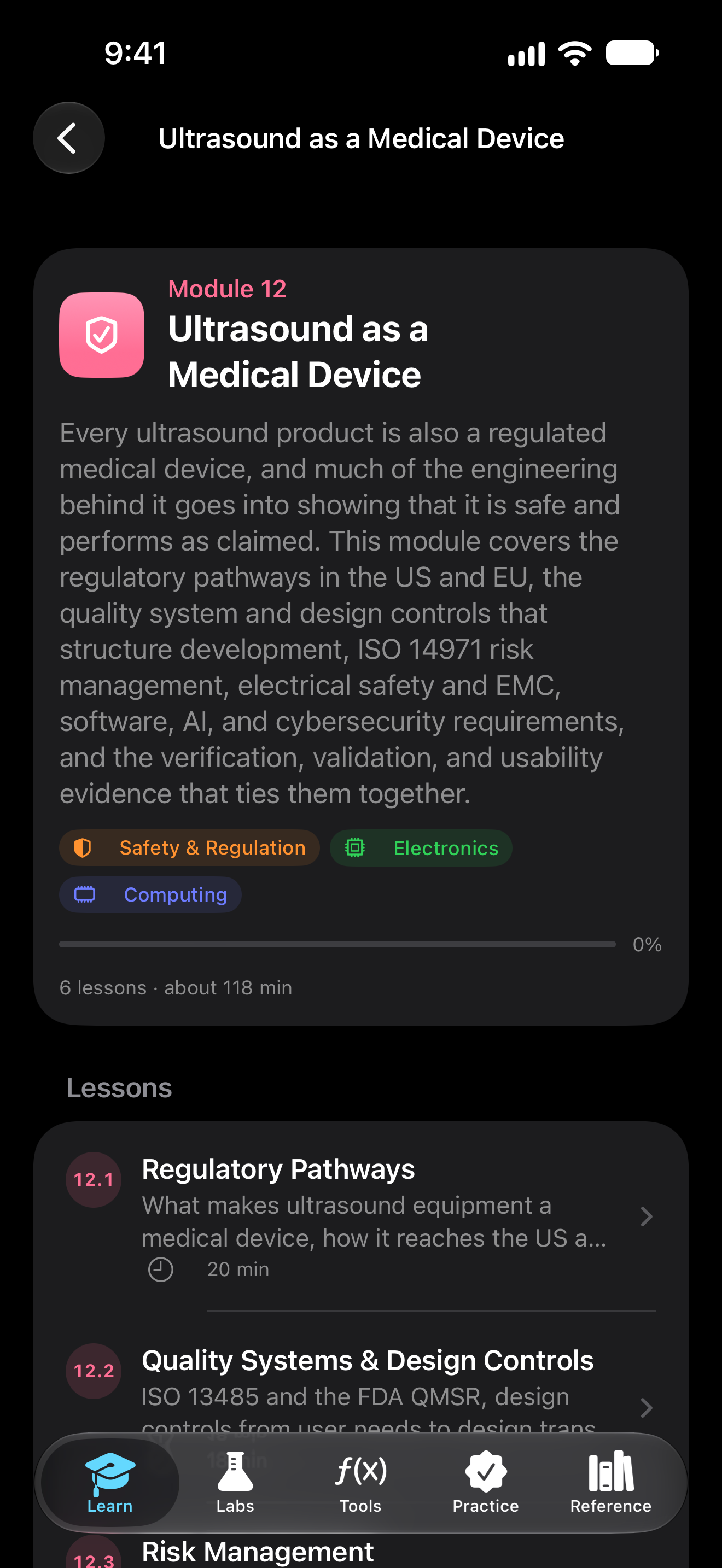
- Ultrasound as a medical device: U.S. and EU regulatory pathways, quality systems and design controls, risk management, electrical safety and EMC, software and cybersecurity, and verification and validation
- The device landscape: handheld and wearable systems, probes inside the body, monitoring devices, low-intensity therapy, HIFU and lithotripsy, and ultrasonic surgical instruments
16 interactive labs
Simulations computed on your device from physical models, each stating its model and simplifications on screen:
- Wave Tank — the 2-D acoustic wave equation solved on the GPU in real time: watch pulses reflect, refract, focus, and scatter
- Reflection & Refraction — send a plane wave onto the boundary between two media and see how much energy reflects and how the transmitted beam bends, out to the critical angle
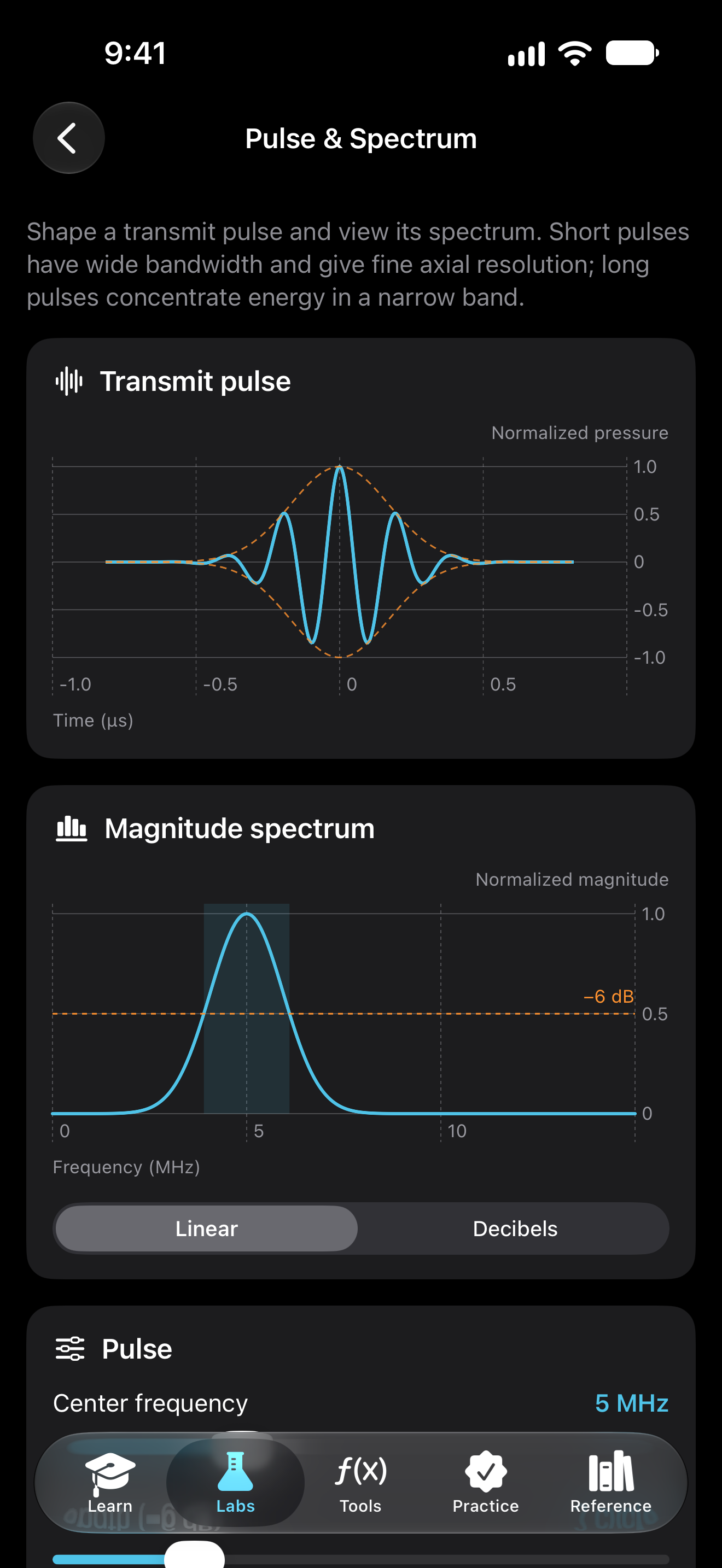
- Pulse & Spectrum — shape a transmit pulse and see the time–bandwidth trade-off behind axial resolution
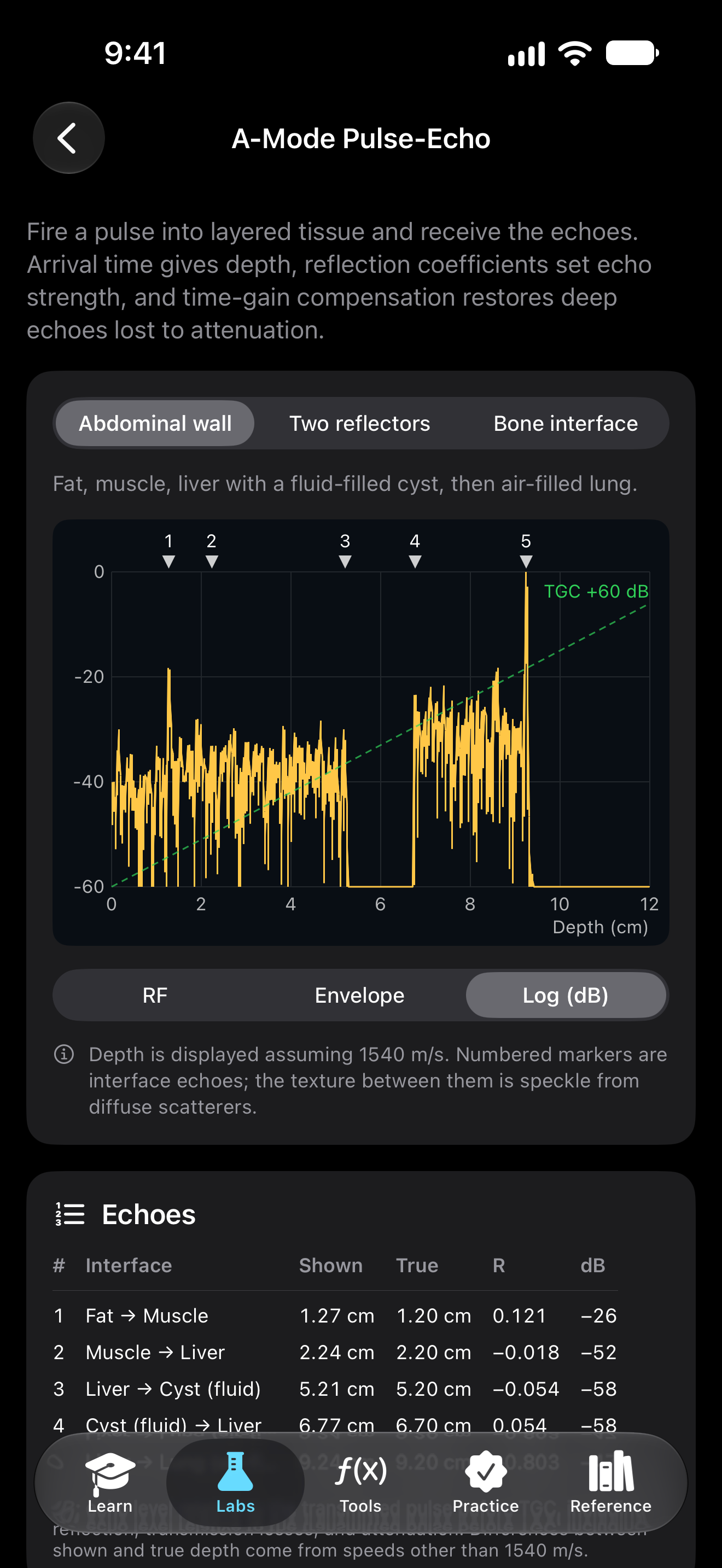
- A-Mode Pulse-Echo — fire a pulse into layered tissue, then read depth, echo strength, and time-gain compensation from the echoes
- Channel Data Beamformer — delay-and-sum beamforming with plane-wave compounding, on a built-in phantom or your own NumPy .npz data
- B-Mode Image Formation — a simulated speckle phantom with cysts, lesions, and wire targets
- Array Beam Pattern — main lobe, side lobes, and grating lobes, with fault injection for dead elements, delay errors, and more
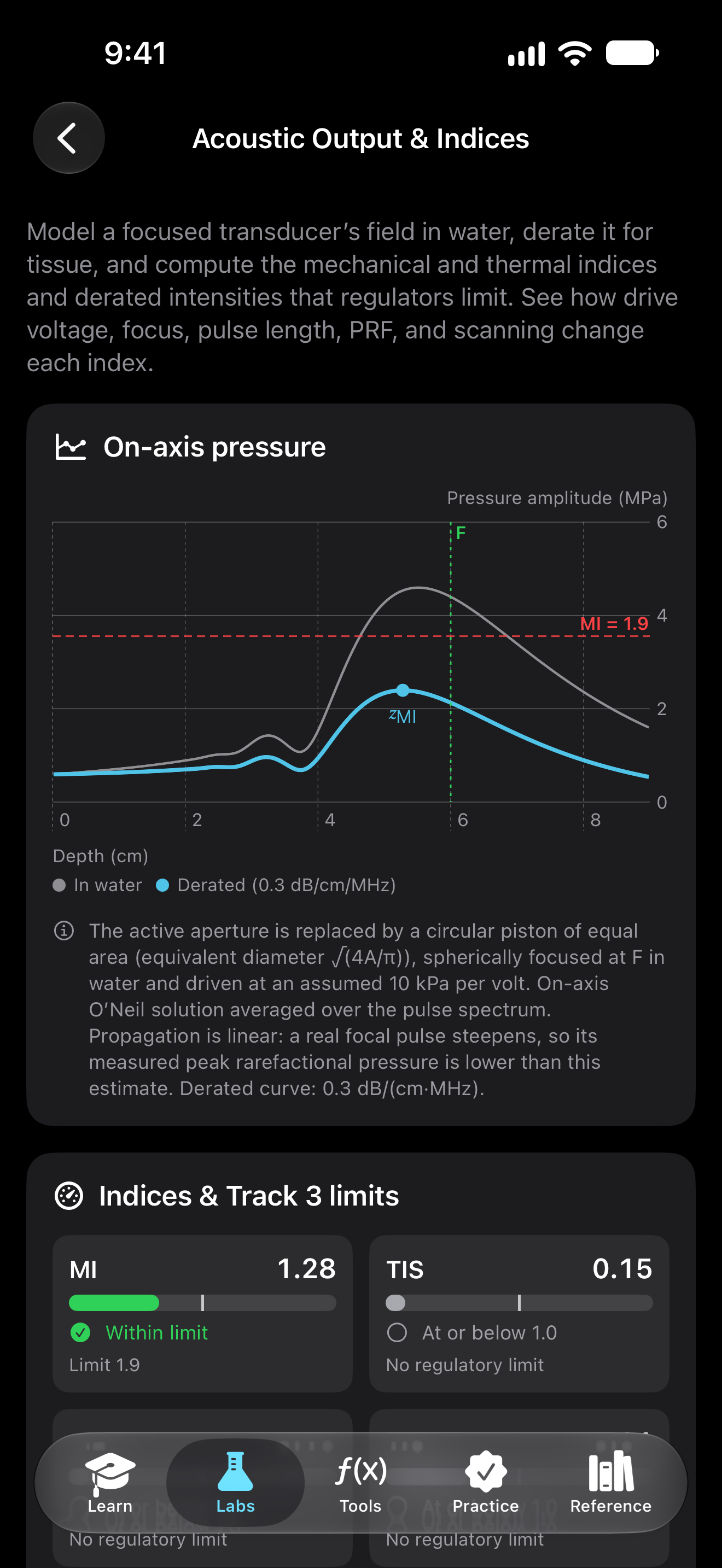
- Acoustic Output & Indices — MI, TIS, TIB, TIC, and derated intensities against FDA Track 3 limits
- Plus wave propagation, attenuation, transducer beams, matching layers, transmit beamforming, the receive signal chain, Doppler aliasing, and the spectral Doppler display
14 engineering tools
Calculators for wave parameters, impedance and reflection, attenuation, decibels, beams and focusing, array design, transducer stacks, range and frame rate, Doppler, shear-wave elastography, acoustic output, and data converters, plus two design tools:
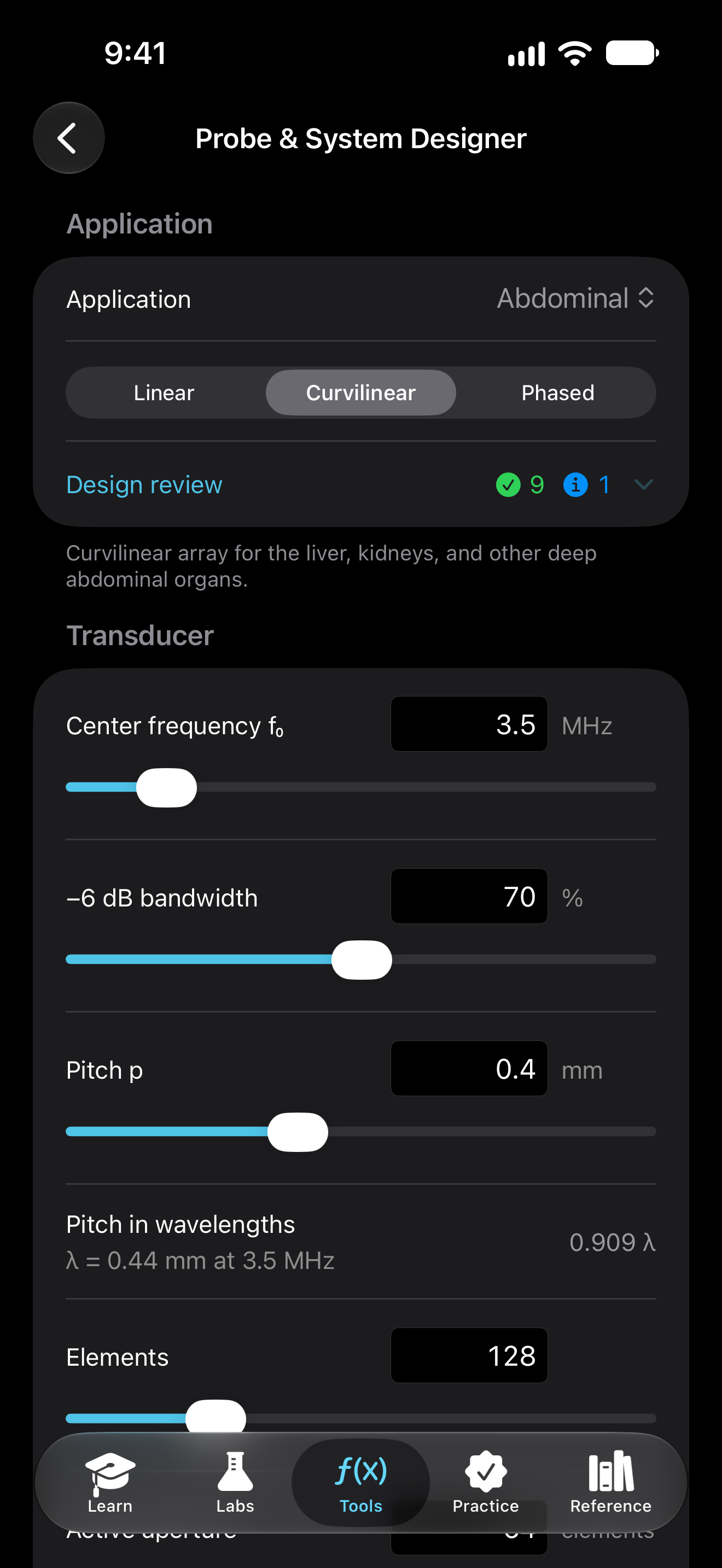
- Probe & System Designer — turns an application into a transducer and system design, then runs a first-pass design review
- Standards Navigator — lists the U.S. and EU regulations and standards likely to apply to a device: an educational starting point, not regulatory advice
Practice that explains
- A quiz for every module — 144 questions in all — plus a 15-question mixed review
- A worked explanation for every answer
- Answer order shuffled on every attempt, with your best score saved
A reference library
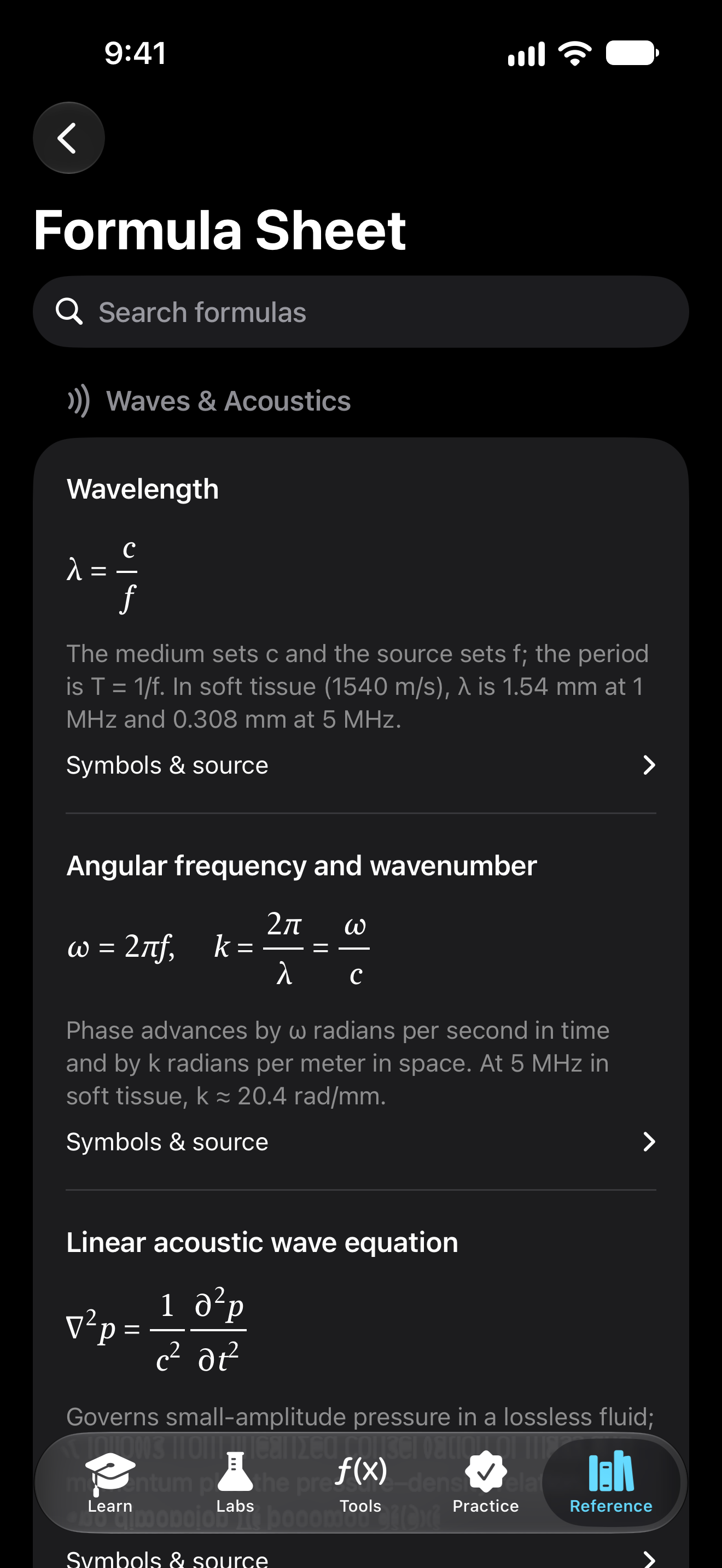
- A searchable formula sheet of 115 formulas and a glossary of 288 terms
- 48 rules of thumb, material properties, and symbols and units
- A gallery of all 58 illustrations
- Further reading: 44 books, papers, standards, regulations, and simulation tools
Built for iPhone and iPad
- Native math typesetting that scales with Dynamic Type and reads aloud with VoiceOver
- Light and dark mode
- Mark lessons complete, bookmark them, and pick up where you left off
Private by design
- No account, no ads, no tracking
- Progress, bookmarks, and quiz scores stay on your device
- Lessons, labs, and tools all work offline
From the wave equation to a probe design review, Ultrasound Fundamentals shows how the physics, mathematics, and engineering of medical ultrasound fit together.
Disclaimer: Ultrasound Fundamentals is an educational resource. It is not a medical device and must not be used for diagnosis or treatment, or to configure clinical equipment. It is not affiliated with, endorsed by, or sponsored by the FDA or any standards organization.